This allows for calculation types to be reordered.
 |
This only affects the display of meter setups where they are all linked to the same meter type and have the same meter # |
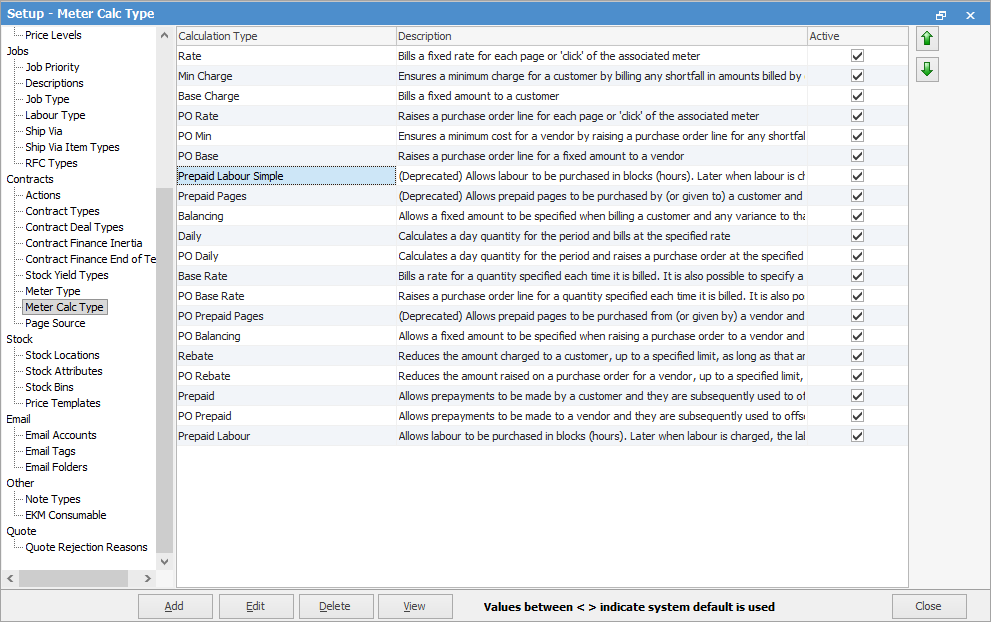
In this section it is possible to disable and reorder these meter calculations types. This only affects the display of a meter setup where they are all linked to the same meter type and have the same meter number.
You can edit the calculation type and untick Active:
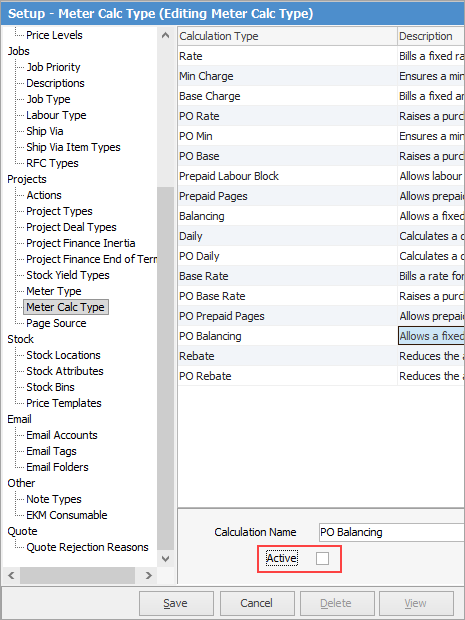
When editing a meter setup, disabled meter calculation types should only be displayed if the current meter setup includes it.
The green up and down arrows at top right allow for calculation types to be reordered. This only affects the display of a meter setup where they are all linked to the same meter type and have the same meter #.
Calculation Type |
Explanation |
|---|---|
Rate |
Will bill a fixed rate for each page (click) of the associated meter. |
Min Charge |
Ensures a minimum charge for a customer by billing any shortfall in amounts billed by other meters. If a meter type is specified, only other charges linked to the same meter and customer will be considered when calculating the minimum charge |
Base Charge |
Bills a fixed amount to a customer. |
PO Rate |
Raises a purchase order line for each page (click) of the associated meter. |
PO Min |
Ensures a minimum cost for a vendor by raising a purchase order line for any shortfall in amounts raised by other meters. If a meter type is specified, only other purchase order lines linked to the same meter and vendor will be considered when calculating the PO Min. |
PO Base |
Raises a purchase order line for a fixed amount to a vendor. |
(Deprecated) Allows labour to be purchased in blocks (hours). Later when labour is charged, the labour charge is reduced by drawing down on the prepaid labour charges. See Prepaid Labour below for further calculations. See here for more detailed information. |
|
(Deprecated) Allows prepaid pages to be purchased by (or given to) a customer and for these prepaid pages to offset the quantity charged to the customer on a Rate meter line. See Prepaid below for further calculations. See here for more detailed information. |
|
Balancing |
Allows a fixed amount to be specified when billing a customer and any variance to that amount calculated is adjusted by this meter, within allowable limits. Can be limited to also only apply to a given meter type. |
Daily |
Calculates a day quantity for the period and bills at the specified rate. |
PO Daily |
Calculates a day quantity for the period and raises a purchase order at the specified rate. |
Base Rate |
Bills a rate for a quantity specified each time it is billed. It is also possible to specify a fixed quantity billed each period. |
PO Base Rate |
Raises a purchase order line for a quantity specified each time it is billed. It is also possible to specify a fixed quantity each period. |
PO Prepaid Pages |
(Deprecated) Allows prepaid pages to be purchased from (or given by) a vendor and for these prepaid pages to offset the quantity raised on a purchase order for a PO Rate meter line. This is limited to just one linked meter.See PO Prepaid for further calculations. See here for more detailed information |
PO Balancing |
Allows a fixed amount to be specified when raising a purchase order to a vendor and any variance to that amount calculated is adjusted by this meter, within allowable limits. Can be limited to also only apply to a given meter type. |
Rebate |
Reduces the amount charged to a customer, up to a specified limit, as long as that amount as been billed by other meters. If a meter type is specified, only other charges linked to the same meter and customer will be considered when calculating the allowed rebate. |
PO Rebate |
Reduces the amount raised on a purchase order for a vendor, up to a specified limit, as long as that amount as been raised by other meters. If a meter type is specified, only other purchase order lines linked to the same meter and vendor will be considered when calculating the allowed rebate. |
Prepaid |
Allows prepayments to be made by a customer and they are subsequently used to offset future charges. See here for more detailed information |
PO Prepaid |
Allows prepayments to be made to a vendor and they are subsequently used to offset future charges from that vendor. See here for more detailed information |
Prepaid Labour |
Allows labour to be purchased in blocks (hours). Later when labour is charged, the labour charge is reduced by drawing down on the prepaid labour charges. See here for more detailed information. |

This works similarly to Prepaid Pages. The main difference is that "Prepaid Pages" works off quantities. "Prepaid" works off currency amounts.
The other difference is that a Prepaid meter can be used to prepay multiple other meters. It is not limited to just one linked meter, as Prepaid Pages is. It uses unders stock codes to handle expired prepaid amounts.
It can optionally purchase another block when needed during billing, either on the same job or purchase order or on a separate job/purchase order.
For block purchases, you can still specify a dollar amount and block size, but when it is purchased, the quantity will be changed to match the dollar amount and the price will be set to $1 (or whatever currency the job/po is in)

This prepaid meter is billed quarterly. It is set to bill a quantity of 1 @ 1000.00. When it is actually billed it will be changed to a quantity of 1000 @ 1 This helps with avoiding rounding problems and allows the current meter count to match the amount of money available in the prepaid bucket.
When this is billed, if we record a read of 1,472 for black and 549 for colour, the following job will be produced:
 ▪The black pages are charged on the first line and offset by the prepaid meter on line 5. ▪The colour pages are charged on the second line and offset by the prepaid meter on line 6. ▪The rental charge is billed on the third line, but as it isn't prepaid by the prepaid meter, it does not have an offsetting line. ▪The fourth line is the prepaid meter billing a periodic billing block which is equal to the prepaid block qty multiplied by price. This is then converted so that the price is $1.
The meter setup for the contract will display that there is $890.90 left in the prepaid bucket.
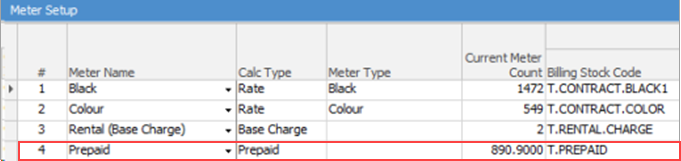
Billing the following month reads of 1915 for black and 919 for colour
 ▪The black and colour again have an offsetting prepaid line. ▪Rental is again charged but not offset. ▪This time however, there is no periodic billing for the prepaid meter, as it is only billed every quarter. |
This works almost the same as Prepaid Labour Simple. The main difference is that Prepaid Labour Simple works off hourly quantities. whereas Prepaid Labour works off currency amounts.
The other main difference is that a prepaid labour meter can be used to prepay multiple other labour meters. It is not limited to just one linked meter, whilst prepaid labour simple is.
Because prepaid labour can prepay multiple labour meters, it can allow labour to be charged out at different rates, but still use the same prepaid labour bucket.

An example might be having a level 1 technician and level 2 technician charged out at different rates.
Notice both the labour meters are marked as Optional and they are both linked to the PREPAID.LABOUR.BLOCK meter.
The above example shows there is $2,218.0 available in the prepaid labour bucket to use. It is set to bill a block of 10 hours @ $180 = $1,800.00.
This will be converted into a quantity of 1,800 at a price of $1.
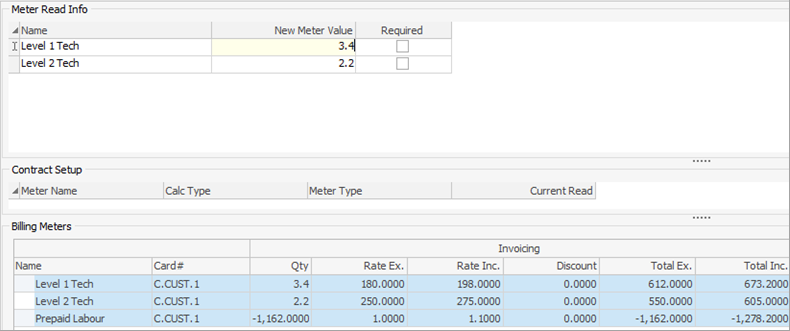
When recording labour against a job, you can specify either one or both.
Entering in only level 2 technician:
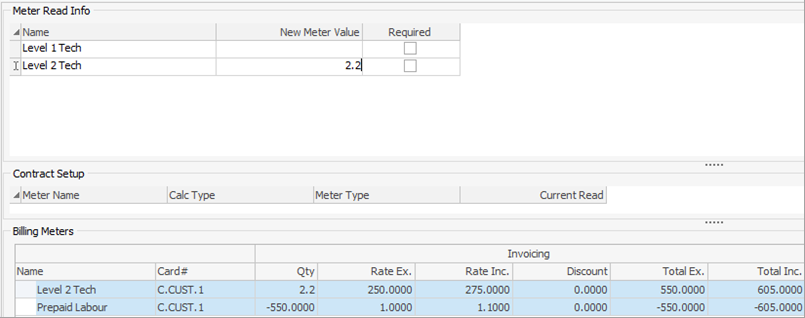
Entering in labour for both:
 |
Further information